Contents
Why can Chinese women’s clothing be updated so quickly and offer such a wide range of prices?
Why Did China Develop Such a Large Women’s Clothing Wholesale Market?
If you come to China for the first time to search for clothing suppliers, you may find this business model unfamiliar. In many countries, clothing procurement is usually completed by brands directly contacting factories or through trading companies. However, in China, there is another very important business system: clothing wholesale markets. They connect factories, suppliers, physical stores, e-commerce sellers, and overseas buyers, and have been an important part of China’s clothing industry for decades.
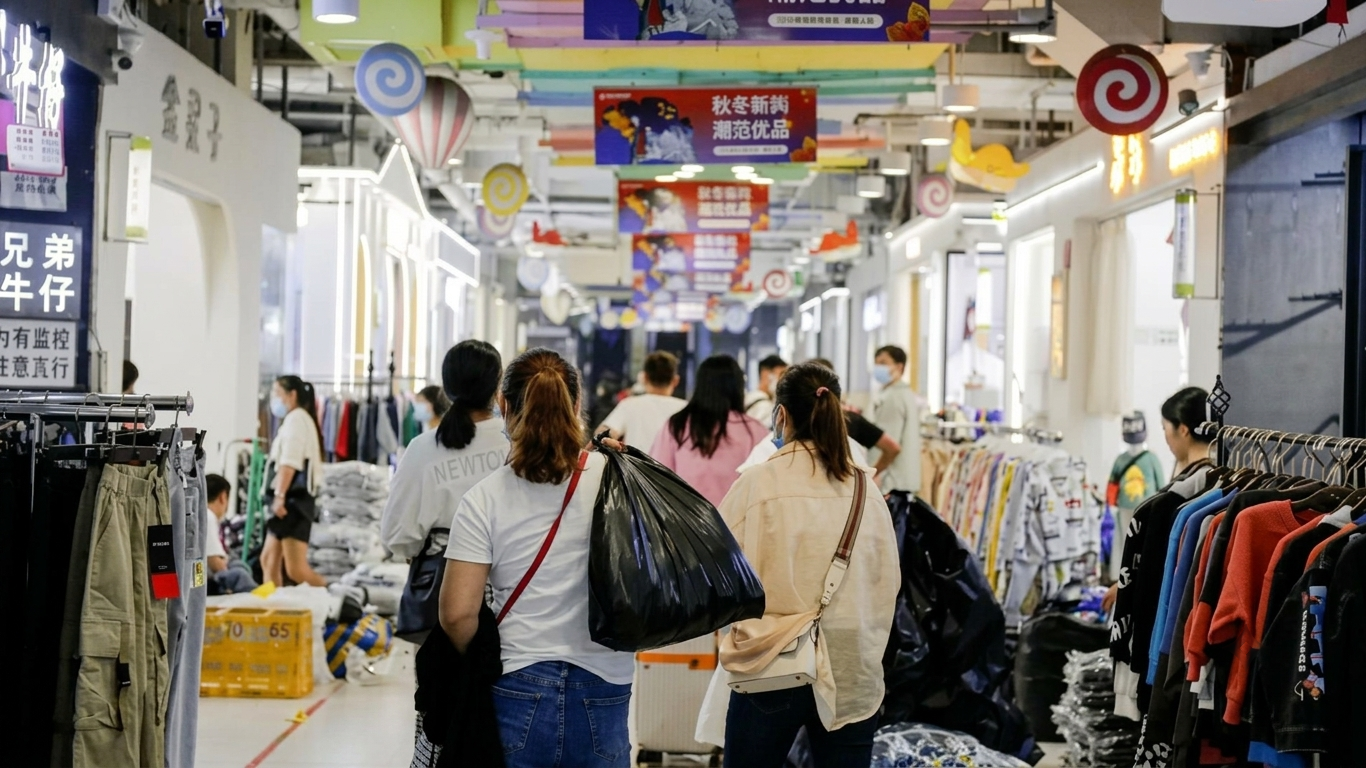
China’s clothing wholesale markets are not simply “places that sell clothes.” Most customers here are not ordinary consumers, but people who operate clothing businesses. They come to the markets to find products suitable for their own sales channels. Some operate street clothing stores and need stable restocking; some run online stores and need to find new products every day; and some overseas buyers hope to purchase products from China with reasonable prices and stable supply.
This unique business model is closely related to the development history of China’s manufacturing industry. Over the past several decades, China’s coastal regions have developed numerous clothing production bases, where large numbers of factories, fabric markets, accessory suppliers, and logistics companies have gathered together, creating a highly specialized system from clothing design and production to sales. When a new style appears, it can quickly complete pattern making, production, and market sales. This efficiency is also an important source of competitiveness for China’s clothing industry.
Many foreign consumers’ understanding of China’s clothing industry may remain at the level of “low-cost manufacturing.” However, the biggest advantage of China’s clothing market is not simply low prices, but the extremely fast response speed of its supply chain. When a fashion trend appears, Chinese suppliers can quickly adjust their products and deliver goods to consumers through wholesale markets, e-commerce platforms, and logistics networks.
The real strength of China’s clothing industry is not only its production cost advantage, but also the fast-moving business network formed between design, manufacturing, and sales.
However, China does not have a single “best clothing market” suitable for everyone. Different cities and different markets serve different needs. Some places are suitable for low-price, high-volume sales, some are suitable for premium women’s clothing, and some specialize in handling inventory products. For overseas buyers, understanding the differences between these markets is more important than simply searching for the lowest price.
Guangzhou: The City with the Most Mature Women’s Clothing Wholesale System in China
If you want to understand China’s women’s clothing wholesale industry, Guangzhou is almost impossible to ignore. Located in southern China, Guangzhou is an important commercial and trade center in China. At the same time, it is close to manufacturing cities such as Shenzhen, Dongguan, and Foshan, giving it a mature clothing production and logistics system. Therefore, Guangzhou became an important center for China’s clothing trade at an early stage.
The biggest characteristic of Guangzhou’s clothing markets is their clear division of functions. Different areas serve different purposes. Some markets focus on meeting mass consumer demand, some focus on design and quality, and some specialize in handling inventory products. This detailed division allows businesses of different sizes to find supply chains suitable for their needs.
For foreign buyers visiting Guangzhou for the first time, the three names they are most likely to encounter are Shahe, Shisanhang, and Qingfeng surplus stock market. Although they all sell women’s clothing, they actually represent different business models within China’s clothing industry.
Shahe: The Wholesale Market Supporting the Rapid Growth of China’s E-commerce Women’s Clothing Industry
Shahe Clothing Wholesale Market is one of Guangzhou’s largest women’s clothing wholesale areas and is also an important source of goods for many Chinese e-commerce sellers. If you observe platforms such as Taobao, Pinduoduo, and Douyin e-commerce in China, you will find that new clothing products are updated extremely quickly. Many stores launch new styles every day, and many of these products come from wholesale markets like Shahe.
The biggest characteristic of Shahe is efficiency. Businesses here usually focus not on how to build a high-end brand, but on what products can be sold quickly and what prices consumers are willing to accept. Therefore, Shahe gathers a large number of women’s clothing products suitable for the mass market, including daily clothing, trendy styles, and products suitable for online sales.
There is a common term in China’s clothing industry called “taking goods(拿货)” For foreign buyers, this term may be unfamiliar. “Taking goods(拿货)” refers to businesses purchasing products through wholesale channels rather than buying individual items like consumers. Wholesale purchases usually require reaching a certain quantity, such as buying multiple pieces of the same style or purchasing according to color and size combinations.
Behind this trading rule are practical reasons. Clothing wholesale markets handle large numbers of orders every day. If every customer only buys one or two pieces of different styles, suppliers would need to spend a large amount of time sorting, packaging, and managing orders, greatly reducing transaction efficiency. Therefore, wholesale markets usually use quantity requirements to reduce operating costs while providing buyers with more competitive prices.
Shahe is very suitable for sellers who need to quickly test the market. For example, someone who has just started a clothing e-commerce business may not know what styles consumers like. They can first purchase a small quantity of products from the wholesale market, judge market reactions through sales results, and then decide whether to continue restocking. This approach reduces entrepreneurial risks and is a common business method among many small and medium-sized Chinese sellers.
However, Shahe does not mean that all products have the same quality. In China’s wholesale markets, there is an important concept called “stall(档口).” A stall refers to a sales booth in a wholesale market. Behind one stall there may be a factory, a trading company, or even just an intermediate link in the supply chain. Therefore, buyers cannot only look at displayed samples. They also need to confirm whether the actual delivered products are consistent and whether the supplier can provide long-term and stable cooperation.
Shahe’s advantages lie in transparent prices, abundant supply, and fast updates. It is very suitable for mass consumer markets, e-commerce sales, and fast turnover business models. However, if the goal is to build a high-end brand, relying only on Shahe may not be the best choice, because its core competitiveness comes more from price and efficiency rather than unique design.
Shisanhang: Why Does It Attract Many Buyers Despite Higher Prices?
Compared with Shahe, Shisanhang represents a part of Guangzhou’s women’s clothing market that focuses more on quality and design. Many people learning about China’s clothing market for the first time may wonder: why can the price of the same women’s clothing item in Shisanhang be significantly higher than in Shahe?
The reason is that clothing prices are not determined only by production costs. The value of a piece of clothing also includes fabric selection, pattern design, production techniques, market positioning, and supply chain capabilities. Many products in Shisanhang are closer to the final retail market. They not only meet the basic need of “having clothes to wear,” but also pay more attention to consumers’ requirements for style and quality.
For boutique women’s clothing stores and e-commerce brand sellers, a higher purchase price does not necessarily mean lower profits. Products with more stable quality and stronger design appeal are often easier for consumers to accept and can reduce later selection and operation costs.
There is a practical rule in China’s clothing industry: cheaper products do not necessarily make more money. Products that match consumer positioning have greater value. If a store selling mid-to-high-end women’s clothing chooses products that are too cheap, it may actually spend more time rebuilding product combinations and adjusting its brand image.
Therefore, Shisanhang is more suitable for buyers who already have clear customer groups, such as boutique physical stores, e-commerce sellers hoping to improve brand image, and businesses targeting medium-to-high consumption markets. It is not a market pursuing the lowest prices, but a market seeking higher product value.
Qingfeng Surplus Stock Market: How Does China’s Clothing Industry Handle Inventory?
Besides newly released clothing products, China also has a special market system: surplus stock markets. Guangzhou Qingfeng Surplus Stock Market is one of the more representative areas.
Surplus stock usually refers to products that were not sold according to the original sales plan, such as remaining factory orders, seasonal inventory from brands, or products accumulated by wholesalers. For the clothing industry, inventory has always been one of the biggest risks because clothing is greatly affected by seasons and fashion trends. Once a batch of products misses the right sales period, its value may quickly decline.
The existence of surplus stock markets helps these inventories return to market circulation. For manufacturers, long-term inventory accumulation means that funds cannot be recovered. Therefore, even if prices are reduced, they still hope to sell the products as quickly as possible. For some low-price sales channels, these products provide opportunities for low-cost purchasing.
When many foreign buyers first hear about surplus stock markets, they are attracted by prices such as “a few yuan per piece.” However, it is important to understand that low prices for surplus stock usually come with greater uncertainty. Within the same batch of products, there may be items with good quality and normal designs, but there may also be products with incomplete size ranges, average workmanship, or minor defects.
Therefore, surplus stock markets are more suitable for experienced buyers or people with low-price sales channels. If the goal is to find stable supply and build a long-term brand, surplus stock is usually not the best choice. Its advantage is extremely low prices, but the cost is the need for stronger selection ability and inventory management capabilities.
Hangzhou: A Women’s Clothing Supply Chain Center Rising in the E-commerce Era
Besides Guangzhou, another very important city in China’s women’s clothing industry is Hangzhou. If Guangzhou represents the development of China’s traditional clothing trade system, then Hangzhou better reflects the impact of China’s e-commerce era on the clothing industry.
Over the past decade, China’s e-commerce industry has developed rapidly. A large number of Taobao store owners, livestream sellers, and online brands have grown in Hangzhou, which has also promoted the development of the local clothing supply chain. Hangzhou not only has many internet companies, but also gathers related industries such as clothing design, photography, operations, and logistics, forming a business ecosystem better suited to online sales models.
Hangzhou Sijiqing Clothing Market is an important women’s clothing wholesale center developed under this industrial background. For many Chinese e-commerce sellers, Guangzhou and Hangzhou are not simply competitors, but two different sources of supply with different characteristics. Guangzhou has a more mature traditional wholesale system, while Hangzhou is closer to online consumer trends.
Sijiqing: Why Do Many E-commerce Sellers Like Coming Here to Find Products?
The biggest feature of Hangzhou Sijiqing is its fast response to market changes and its close connection with online sales. Many sellers come here not only to purchase clothing, but also to observe market trends. They pay attention to which colors are becoming popular, which styles consumers prefer, and which designs are suitable for presentation through pictures and short videos.
Compared with some large traditional wholesale markets in Guangzhou, Sijiqing generally has a more comfortable shopping environment. Some traditional wholesale markets in Guangzhou have extremely crowded daily traffic and a very fast pace, while the environment in Sijiqing is relatively more relaxed, allowing buyers more time to observe products and communicate with suppliers.
However, for people truly engaged in the clothing business, the environment is not the most important factor. The most important thing is judging whether the product matches market demand. Many people who are new to the clothing industry make the same mistake: they see a piece of clothing they personally like and assume consumers will like it too. But there is a clear difference between clothing business and personal taste. A piece of clothing with a very unique design may still be difficult to sell if target consumers do not accept it.
Experienced clothing sellers usually consider questions such as: Who are my customers? How much are they willing to pay? Does this style match current market trends? This is why many clothing professionals say that running a clothing business is not simply about selling your own aesthetic preferences, but about understanding consumer demand.
What the clothing industry truly sells is not just clothing, but the ability to judge consumer needs.
There are also different levels of suppliers within Sijiqing. Some stalls provide affordable mass-market women’s clothing, some focus more on design and quality, and some suppliers are more suitable for physical stores and mid-to-high-end channels. Therefore, for overseas buyers, it is best to define their market positioning before coming to Sijiqing.
If your customers prefer fast-changing, reasonably priced fashion clothing, Sijiqing can provide a wide range of choices. If your goal is to build a high-end brand, you need to further search for suppliers with design capabilities and production capabilities rather than simply relying on wholesale markets.
Shenzhen Nanyou: An Important Market for China’s Mid-to-High-End Women’s Clothing and Design Supply Chain
Besides Guangzhou and Hangzhou, Shenzhen Nanyou is also a frequently mentioned market in China’s women’s clothing industry.
Unlike Guangzhou, Shenzhen is not only a traditional manufacturing city, but also an important center for innovative companies and international trade in China. Therefore, Nanyou’s clothing market is generally more focused on mid-to-high-end women’s clothing, design-oriented products, and brand supply chains.
If Shahe represents fast sales and the mass market, and Shisanhang represents quality women’s clothing, then Nanyou is closer to original design and mid-to-high-end business models. Some suppliers here pay more attention to fabrics, patterns, and product development capabilities. For buyers looking for boutique women’s clothing, building brands, or serving higher-spending customer groups, Nanyou is highly attractive. At the same time, it also requires stronger purchasing experience.
China’s clothing market has one characteristic: two pieces of clothing that look similar on the outside may have completely different production standards behind them. Fabric quality, cutting methods, and craftsmanship details all affect the final product value. Therefore, when purchasing from Nanyou, buyers cannot only look at pictures or first impressions, but need to truly understand the supplier’s production capabilities.
For overseas buyers, if consumers in their target market care more about design and quality, Nanyou may provide more value than wholesale markets that focus purely on low prices.
What Other Links in China’s Clothing Supply Chain Are Easily Overlooked by Foreign Buyers?
Many foreign buyers visiting China for the first time focus their attention on wholesale markets. However, China’s clothing supply chain is far more complex than just a single market.
Beyond wholesale markets, there are also many suppliers operating behind the scenes. For example, some supply chain companies integrate resources from multiple factories and provide customers with services such as product selection, product development, production, and delivery. For overseas buyers without experience purchasing in China, these companies can sometimes be more convenient than directly searching for individual stalls.
The reason is that China’s clothing industry has a highly detailed division of labor. A factory may only specialize in producing one type of product, such as sweaters, pants, or jackets, and may not be responsible for complete sales. A mature supply chain service provider, however, can help buyers connect different production processes.
For example, if a customer wants to develop a women’s clothing collection, they may need different factories to produce knitwear, coats, dresses, and accessories. Without local experience, it can be difficult to quickly find suitable suppliers. Supply chain companies can use their industry resources to reduce communication costs.
However, overseas buyers also need to understand that not every intermediary can provide real value. Some only resell products and increase prices. Therefore, when choosing partners, buyers need to pay attention to their industry experience, supply capabilities, and whether they can provide real production information.
Why Are Many Beginners Not Recommended to Directly Find Factories for Production at the Beginning?
Many people who are just starting a clothing business have an idea: since there is profit potential in wholesale markets, why not directly find factories to produce their own products?
In theory, direct production can indeed reduce costs. However, for beginners without experience, it is also one of the riskiest approaches. Clothing production is not simply telling a factory “make a piece of clothing.” From design, pattern making, and fabric selection, to confirming craftsmanship and controlling quality, every step requires experience. If any part of the process goes wrong, the final products may not be able to sell.
More importantly, the biggest risk in the clothing industry is not production, but inventory. A style may be very popular today, but consumer interest may have already changed several months later. If a large quantity of products is produced in advance, unsold inventory can become a major business burden.
Therefore, many experienced clothing sellers do not invest large amounts of money into production at the beginning. Instead, they first test market reactions through wholesale markets. After confirming that a certain type of product has stable demand, they gradually develop their own supply chains.
For overseas entrepreneurs entering China’s clothing market for the first time, learning market rules before increasing investment is usually safer than pursuing the highest profit from the beginning.
What Should Overseas Buyers Pay Attention to When Coming to China for Women’s Clothing Suppliers for the First Time?
For foreign buyers without experience purchasing in China, the biggest challenge in China’s clothing market is not finding products, but judging which suppliers are truly suitable for them.
Many people visiting China for the first time tend to search for the “lowest price.” However, in real business, the lowest price does not necessarily represent the best choice. A product with a very low price may create more costs in the end if its quality is unstable or supply cannot be maintained.
A more reasonable approach is to first define your market positioning.
If your customers care about price and fast updates, markets like Guangzhou Shahe may be more suitable. If your customers care about quality and design, you can consider Shisanhang, Hangzhou Sijiqing, or Shenzhen Nanyou. If you hope to build your own brand, you need to further search for factory and supply chain partners.
During the first purchase, it is also not recommended to place large orders immediately. A more reliable approach is to first conduct small-batch testing, understand product quality, sales feedback, and supplier cooperation methods, and then gradually expand purchasing volume.
At the same time, overseas buyers also need to adapt to some characteristics of the Chinese business environment. For example, Chinese suppliers usually prefer using WeChat for daily communication rather than relying completely on email. Many long-term business relationships are built on trust and continuous communication, rather than only on a contract.
China’s clothing wholesale markets may look complicated, but there is a very clear business logic behind them. Cities such as Guangzhou, Hangzhou, and Shenzhen are not simply places that sell clothes, but play different roles in the global clothing industry chain.
By understanding the rules behind these markets, what you see is not just several wholesale markets, but a supply chain system that supports China’s clothing industry in connecting with consumers around the world.