Contents
Behind China’s glowing drone shows is a powerful manufacturing ecosystem.
Why Are Drone Shows Everywhere in China?
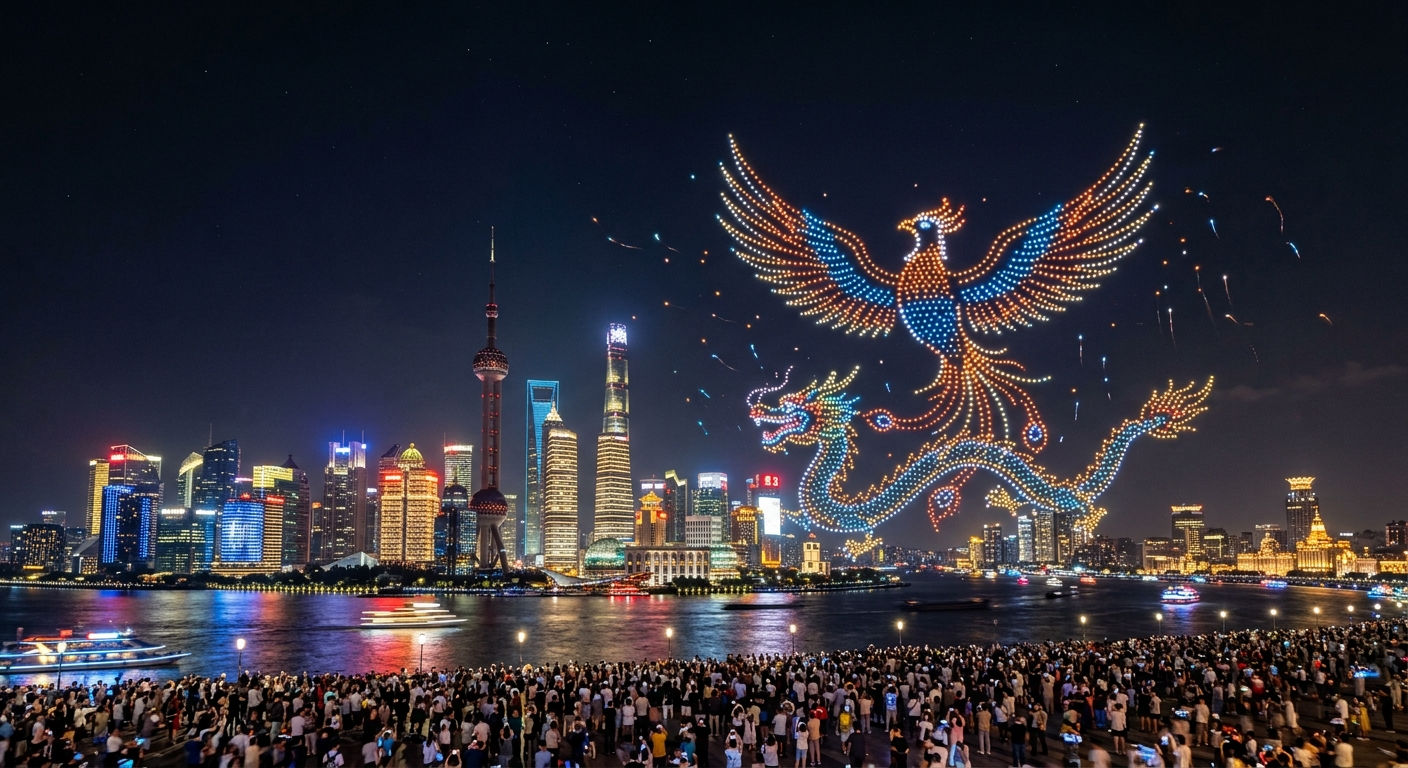
If you have followed Chinese city events, tourism campaigns, or business activities in recent years, you may have noticed an increasingly common scene: at night, hundreds or even thousands of drones rise into the sky, using lights and precise positioning technology to create moving images. Sometimes they form the shape of a city landmark, sometimes a company logo, and sometimes even a complete animated story. A technology that was once limited to major international events has now entered city celebrations, brand launches, tourism promotions, and even personal occasions such as marriage proposals and birthday parties.
For many foreign audiences, this phenomenon may seem unusual. In many countries, drones are mainly understood as tools for photography, industrial applications, or military technology. In China, however, drones have developed another important use: large-scale drone light shows. These performances use software to control the position, movement, and lighting of thousands of drones at the same time, allowing them to create complex patterns and images in the sky. Compared with traditional fireworks, drone shows are more controllable, reusable, and can be customized for different themes.
The rapid popularity of drone shows in China is not simply because people suddenly became interested in high-tech entertainment. It is the result of several factors coming together. Chinese cities have increasingly invested in night-time tourism and cultural events, while companies have been looking for new ways to attract attention in a highly competitive market. At the same time, China’s mature electronics manufacturing ecosystem has significantly reduced the cost of producing and operating drone shows.
The real transformation brought by drone shows is not only the visual experience in the sky, but also the process of turning a technology once limited to laboratories and major events into a service that ordinary businesses and individuals can purchase.
This development follows a common pattern in China’s technology industries: first, a new technology appears; then companies improve production efficiency and reduce costs; finally, the technology enters a wider consumer market. Similar processes have happened with smartphones, electric vehicles, and smart home products.
From Intel’s World Records to the Rise of Chinese Companies
China was not the first country to develop drone shows. In the early stage of this industry, American technology company Intel was one of the most influential players.
In 2012, the Ars Electronica Futurelab in Austria conducted one of the earliest outdoor drone art performances, using only dozens of drones. As technologies such as GPS positioning, miniature processors, wireless communication, and battery systems improved, drones gradually became capable of coordinated flight.
Intel entered the drone show industry for a different reason. As one of the world’s largest semiconductor companies, Intel faced major challenges during the smartphone revolution. The traditional PC market was slowing down, while the mobile chip market was dominated by other companies. Drone shows became a way for Intel to demonstrate technological capability and rebuild its public image.
In 2017, during the Super Bowl halftime show in the United States, Intel used 300 drones to create images in the sky alongside Lady Gaga’s performance. The show attracted global attention. One year later, at the 2018 PyeongChang Winter Olympics in South Korea, Intel used 1,218 drones to create the Olympic rings, setting a new world record at the time.
However, the drone show industry developed much faster than many expected. Shortly after the PyeongChang Olympics, Chinese companies entered the market and quickly expanded the scale of drone performances. Chinese companies such as EHang from Guangzhou and HighGreat from Shenzhen began creating larger and more complex drone formations, increasing the number of drones from hundreds to thousands and eventually tens of thousands.
The reason Chinese companies were able to catch up so quickly was not simply because they had more drones. The deeper advantage came from China’s complete industrial chain. From hardware manufacturing and software development to large-scale event execution, Chinese companies could improve products and deliver commercial projects much faster.
How Did China Create a New Market After Firework Restrictions?
Another important reason behind the rapid growth of drone shows in China was the changing environment surrounding traditional fireworks.
For many years, fireworks were a major part of celebrations in China. Cities, companies, and tourism destinations often used fireworks during festivals and important events because they created a strong visual impact. However, starting around 2015, many Chinese cities gradually introduced stricter restrictions on fireworks due to safety and environmental concerns.
These restrictions reduced one traditional form of entertainment, but the demand for large-scale visual experiences did not disappear. Cities still needed attractive performances for tourism promotion, companies still needed impressive events for marketing, and people still wanted memorable celebrations.
Drone shows filled this gap.
Compared with fireworks, drone performances offer several advantages. They can be reused, precisely controlled, and designed with specific cultural or commercial messages. A city can display its landmarks in the sky, a company can show its brand logo, and a tourism destination can create a unique nighttime attraction.
At the same time, China’s drone industry itself was undergoing major changes. During the early stage of the consumer drone market, hundreds of companies entered the industry, creating intense competition. As the market matured, some companies struggled to compete with leading brands and began searching for new opportunities.
Drone shows became one of those opportunities.
Some companies discovered that existing drones could be modified for performance purposes by adding LED lights and improving formation-control software. On one side were drone companies looking for new markets; on the other side were cities and businesses looking for alternatives to fireworks. These two needs created a completely new industry.
This also explains why drone shows became much cheaper over time. In the early years, large-scale drone performances were extremely expensive and mainly available for international events. But as Chinese companies expanded production, gained experience, and improved technology, costs decreased significantly.
Today, drone shows are no longer only a luxury display for global events. They have become a commercial service available for many different occasions.
Why Are Many Leading Drone Show Companies Located in Guangdong?
If you look at China’s drone show industry, one feature becomes very clear: many leading companies come from Guangdong, especially Shenzhen and Guangzhou.
This is not a coincidence.
Guangdong has been one of China’s most important manufacturing regions since the beginning of economic reform. The Pearl River Delta region has developed one of the world’s largest electronics manufacturing ecosystems, with suppliers producing chips, batteries, motors, sensors, communication modules, and other components.
For a drone company, the biggest advantage is not just the low price of individual parts. The real advantage is the entire supply chain being located nearby. When engineers design a new product, they can quickly communicate with suppliers, test different components, make adjustments, and begin production.
Shenzhen is often described as a “paradise for hardware innovation” because of this ecosystem. A startup can design a product concept and quickly find manufacturers, engineers, and suppliers who can help turn the idea into a real product.
This ability to move quickly is one of the strongest competitive advantages of Chinese manufacturing.
The same logic can be found in many other industries in Guangdong, including electric vehicles, robotics, smart devices, and consumer electronics. These industries require constant testing, improvement, and rapid production, and Guangdong’s manufacturing network provides exactly that environment.
Drone shows are therefore not just an entertainment product. They are a visible example of how China’s industrial ecosystem works.
Behind Drone Shows Is a New Version of Chinese Manufacturing
When people watch a drone show, they usually focus on the final image in the sky. However, the real competitiveness of this industry comes from the complex system behind it.
A large-scale drone performance is not simply about buying thousands of drones. It requires software design, flight planning, communication systems, safety management, and professional teams that can operate the event. It combines hardware manufacturing, software engineering, and service capabilities.
This reflects a broader change in Chinese manufacturing.
For many years, the outside world often associated “Made in China” mainly with low-cost mass production. Today, however, Chinese companies are increasingly competing through technology, integrated solutions, and complete industrial ecosystems.
The drone industry is a good example. Chinese companies do not only manufacture drones; they provide complete services, including equipment, software, technical support, and international project execution.
For overseas markets, this model is highly competitive. A country may have excellent research institutions, but without a mature supply chain, turning technology into affordable commercial products is much more difficult. China’s advantage comes from connecting innovation, manufacturing, and market demand.
How Are Chinese Drone Shows Expanding Globally?
As the domestic market becomes more mature, Chinese drone show companies are increasingly entering international markets.
In recent years, Chinese teams have participated in large-scale events in the Middle East, Southeast Asia, and Europe. For local audiences, these events are simply impressive nighttime performances, but behind them may be Chinese equipment, Chinese software, and Chinese technical teams.
Drone shows may look like entertainment, but they represent a larger transformation in Chinese manufacturing: moving from simply producing products to providing technology-based services and complete solutions.
In the future, with the development of artificial intelligence, robotics, and smart hardware, more industries may follow a similar path.
When thousands of drones create a moving galaxy above the city, people are not only seeing the beauty of technology. They are also seeing the industrial network built by countless factories, engineers, and workers that has supported China’s rise in advanced manufacturing.